

Certification Training for AD0-E724 Exam Dumps Test Engine [2025]
Nov 27, 2025 Step by Step Guide to Prepare for AD0-E724 Exam
NEW QUESTION # 52
What does a URL Rewrite do?
- A. It changes the way a URL appears in the browser
- B. It updates the URL that is stored on the server.
- C. It updates the URL to a domain that is not being Indexed.
Answer: A
Explanation:
A URL Rewrite in Magento changes the way a URL appears in the browser. This is particularly useful for improving the readability and SEO of a URL. For example, a URL rewrite can be used to transform a long and complex URL into a shorter and more user-friendly version. It's important to note that while a URL rewrite changes the URL's appearance in the browser, it doesn't change the actual location of the resource on the server. This distinction is crucial for understanding how Magento handles URL rewrites and redirects, facilitating a more intuitive navigation structure within the store without altering the underlying server resources.
NEW QUESTION # 53
What are two features with Adobe Commerce Cloud that come out of the box? (Choose Two.)
- A. Fastly
- B. Support ACL
- C. Continuous deployment provided with the platform
- D. A built in connector with all major blog platforms
Answer: A,C
Explanation:
Adobe Commerce Cloud offers several out-of-the-box features, including built-in Fastly integration for CDN and web application firewall services, as well as continuous deployment capabilities through its cloud infrastructure.
* Continuous Deployment:
* Adobe Commerce Cloud supports continuous deployment workflows, allowing code to be automatically built, tested, and deployed through its integration with Git and cloud CI/CD pipelines.
* Fastly Integration:
* Fastly is included as a CDN and caching layer with Adobe Commerce Cloud, offering improved site speed and security through caching and a web application firewall.
* Why Options B and D are Correct:
* Both of these features are inherent to Adobe Commerce Cloud. Option A (Support ACL) is a part of the Magento Admin Panel but is not a cloud-specific feature, and Option C (Blog platform connector) is not provided out-of-the-box.
NEW QUESTION # 54
An Adobe Commerce developer is working on a Magento 2 instance which contains a B2C and a B2B website, each of which contains 3 different store views for English, Welsh, and French language users. The developer is tasked with adding a link between the B2C and B2B websites using a generic link template which is used throughout the sites, but wants these links to display in English regardless of the store view.
The developer creates a custom block for use with this template, before rendering sets the translate locale and begins environment emulation using the following code:
They find that the template text is still being translated into each stores language. Why does this occur?
- A. startEnvironmentEmuiation() resets the translation locale to the one of the emulated stores, which overrides the locale the developer has set when the order of setLocate and startEnvironmentEmulation is used as displayed above.
- B. setLocate() does not change translation locale after it has been initially set, the $this->_translate-
>emulate($newLocaiecode) method exists to temporarily modify this by pushing the new locale to the top of the current emuiatedLocales stack. - C. startEnvironmffntEmulation() SetS and locks the locale by Using the setLocale() Optional Second
$lock parameter, i.e. setLocale($newLocaleCode,
true), to override and lock the locale of the emulated store. If this is set and locked initially then the environment emulation will not be able to override this.
Answer: A
Explanation:
ThestartEnvironmentEmulation()method resets the translation locale to the one of the emulated stores, which overrides the locale the developer has set when the order ofsetLocale()andstartEnvironmentEmulation()is used as displayed above.
The correct way to achieve the desired result is to use theemulate()method to temporarily modify the translation locale. The following code shows how to do this:
PHP
$this->_translate->emulate('en_US');
// Render the template
$this->_translate->revert();
This code will set the translation locale to English before rendering the template, and then revert the locale back to the default value after the template has been rendered.
ThestartEnvironmentEmulation()method is used to emulate a different store view or website. This can be useful for testing purposes, or for developing features that need to work in different environments.
Theemulate()method is used to temporarily modify the translation locale. This can be useful for rendering templates in a specific language, or for testing features that need to work in different languages.
NEW QUESTION # 55
What folder would a developer place a custom patch on an Adobe Commerce Cloud project to have it automatically applied during the build phase?
- A. Add the patch file to the m2-hotfixes/ directory
- B. Add the patch file to the patches/ directory
- C. Add the patch file to the m2-patches/ directory
Answer: A
Explanation:
On an Adobe Commerce Cloud project, a custom patch should be placed in them2-hotfixes/directory to have it automatically applied during the build phase. The patches in this directory are applied in alphabetical order and can be used to apply quick fixes to the code that will be included in the build artifact.
NEW QUESTION # 56
There is an integration developed using a cron service that runs twice a day, sending the Order ID to the integrated ERP system if there are orders that are able to create an invoice. The order is already loaded with the following code:
$order = $this->orderRepository->get($orderId);
In order to verify if the store has invoices to be created, what implementation would the Adobe Commerce developer use?
- A.

- B.

- C.

Answer: C
Explanation:
The correct implementation to check if an order is eligible for invoicing is to use the $order->canInvoice() method. This method checks whether the order meets all necessary conditions for an invoice to be created, such as the order not being fully invoiced or canceled.
Option A is correct for the following reasons:
* Using canInvoice() for Invoicing Eligibility:The $order->canInvoice() method is specifically designed to verify if an order can have an invoice generated. It returns true only if the order is in a state where it can be invoiced. This makes it the appropriate method for determining whether the order should be sent to the ERP system for invoicing.
* Explanation: The canInvoice() method is part of the Magento\Sales\Model\Order class and checks a variety of conditions to determine if invoicing is possible. This includes ensuring that the order is not fully invoiced or canceled, which are critical conditions in Adobe Commerce's order processing workflow.
NEW QUESTION # 57
Which log file would help a developer to investigate 503 errors caused by traffic or insufficient server resources on an Adobe Commerce Cloud project?
- A. access.log
- B. cloud.log
- C. mysql-slow.log
Answer: A
Explanation:
The access.log file stores the information about the requests and responses that occur on the web server, such as the IP address, timestamp, request URI, response code, andreferer URL1. By checking the access.log file, a developer can identify the requests that resulted in 503 errors and the possible causes of those errors, such as traffic spikes, insufficient server resources, or misconfiguration1.
To check the access.log file on an Adobe Commerce Cloud project, a developer can use the following command in the CLI:
grep -r "\" 50 [0-9]" /path/to/access.log
This command will search for any lines in the access.log file that contain a response code starting with 50, which indicates a server error1. The developer can then compare the timestamps of those lines with the exception.log and error.log files to find more details about the errors1.
Alternatively, if the error has occurred in the past and the access.log file has been rotated (compressed and archived), the developer can use the following command in the CLI (Pro architecture only):
zgrep "\" 50 [0-9]" /path/to/access.log.<rotation ID>.gz
This command will search for any lines in the compressed access.log file that contain a response code starting with 501. The rotation ID is a number that indicates how many times the log file has been rotated. For example, access.log.1.gz is the most recent rotated log file, and access.log.10.gz is the oldest rotated log file1.
NEW QUESTION # 58
A seller would like to offer an electronic version of an album by selling each song individually. Which layout can be used to customize a product page layout for this item?
- A. catalog_product_view_type_downloadable
- B. catalog_product_view_type_configurable
- C. catalog_product_view_category
Answer: A
Explanation:
Thecatalog_product_view_type_downloadablelayout can be used to customize a product page layout for a downloadable product. This layout includes the product details, the product reviews, and the download links for the product's files.
For selling electronic versions of albums with individual songs, the downloadable product type in Adobe Commerce is appropriate. To customize the product page layout specifically for downloadable items, the layout handlecatalog_product_view_type_downloadableis used. This layout handle allows developers to target downloadable products specifically and apply custom layouts or templates, making option A correct.
NEW QUESTION # 59
The value of a product attribute in the Adobe Commerce system needs to have a different format before it is displayed. Which attribute model class is responsible for this?
- A. Frontend
- B. Backend
- C. Source
Answer: A
Explanation:
The frontend attribute model class is responsible for formatting the value of a product attribute before it is displayed on the storefront. This class can implement methods such as getValue, getLabel, getInputType, and getOptionText to modify the attribute value.
The backend attribute model class is responsible for saving and loading the attribute value to and from the database. The source attribute model class is responsible for providing the list of options for an attribute.
Verified References: [Adobe Commerce Developer Guide - Attribute models] In Adobe Commerce (Magento 2), the formatting of product attribute values before they are displayed is handled by the attribute's frontend model. The frontend model, typically extending
\Magento\Eav\Model\Entity\Attribute\Frontend\AbstractFrontend, is responsible for preparing the attribute value for display in the frontend, including formatting dates, adding pricing structures, and more.
The backend model deals with saving and loading attribute data, while the source model provides options for select attributes.
NEW QUESTION # 60
An Adobe Commerce developer has added an iframe and included a JavaScript library from an external domain to the website. After that, they found the following error in the console:
Refused to frame [URL] because it violates the Content Security Policy directive.
In order to fix this error, what would be the correct policy ids to add to the csp_whitelist.xml file?
- A. frame-src and script-src
- B. frame-ancestors and connect-src
- C. default-src and object-src
Answer: A
Explanation:
The Content Security Policy (CSP) in Adobe Commerce (Magento) restricts the types of content that can be loaded on a page to protect against malicious attacks, such as cross-site scripting (XSS). When an iframe is added, and a JavaScript library is loaded from an external source, these resources must be whitelisted explicitly using the csp_whitelist.xml file.
In this specific case:
* The frame-src directive controls the sources from which iframes can be embedded. Since the developer is embedding an iframe from an external domain, they need to whitelist this domain for frame-src.
* The script-src directive controls the sources from which JavaScript files can be loaded. The external JavaScript library must be whitelisted under script-src to allow it to execute.
Therefore, the correct policy IDs to whitelist are:
* frame-src: to allow the embedding of content from an external domain in an iframe.
* script-src: to allow the loading and execution of JavaScript files from the external domain.
Here's how to update the csp_whitelist.xml file with the correct directives:
<?xml version="1.0"?>
<whitelist
xmlns:xsi="http://www.w3.org/2001/XMLSchema-instance" xsi:noNamespaceSchemaLocation="urn:
magento:module:Magento_Csp:etc/csp_whitelist.xsd"
>
<policy id="frame-src">
<values>
<value id="your-external-domain.com"/>
</values>
</policy>
<policy id="script-src">
<values>
<value id="your-external-domain.com"/>
</values>
</policy>
</whitelist>
Replace your-external-domain.com with the actual domain of the external iframe and JavaScript source.
Additional Resources:
* Adobe Commerce Developer Guide: Content Security Policy (CSP)
* CSP Policies and Directives: Explanation of all supported CSP directives and how to configure them.
NEW QUESTION # 61
A developer found a bug inside a private method of a third party module class. How can the developer override the method?
- A. Create a custom class with corrected logic, and define the class as preference in the preferences.xml.
- B. Create a plugin, implement correct logic in the after" method, and then define the plugin in the di.xml.
- C. Create a custom class with the corrected logic, and define the class as a preference for original one in the di xml.
Answer: C
Explanation:
To override a private method in a third-party module class, the most effective approach is to use a preference.
This involves creating a custom class with the corrected logic and then defining this class as a preference for the original one in thedi.xmlfile. Plugins cannot be used to override private methods, final methods, final classes, or classes created without dependency injection. Therefore, the preference mechanism, which allows for the substitution of the entire class, becomes the viable method to override a private method and modify its behavior.
NEW QUESTION # 62
An Adobe Commerce developer is tasked with adding custom data to orders fetched from the API. While keeping best practices in mind, how would the developer achieve this?
- A. Create an extension attribute On Magento\Sales\Api\Data\OrderInterface and an after plugin On Magento\Sales\Api\OrderRepositoryInterface On geto and getListo to add the custom data.
- B. Create an extension attribute on Nagento\sales\Api\E)ata\orderinterface and an after plugin on Magento\Sales\Model\Order: :getExtensionAttributes() to add the custom data.
- C. Create a before plugin on Magento\sales\model\ResourceModel\order\collection: :load and alter the query to fetch the additional data. Data will then be automatically added to the items fetched from the API.
Answer: A
Explanation:
The developer should create an extension attribute on theMagento\Sales\Api\Data\OrderInterfaceinterface and an after plugin on theMagento\Sales\Api\OrderRepositoryInterface::get() andMagento\Sales\Api\OrderRepositoryInterface::getList()methods.
The extension attribute will store the custom data. The after plugin will be used to add the custom data to the order object when it is fetched from the API.
Here is the code for the extension attribute and after plugin:
PHP
namespace MyVendor\MyModule\Api\Data;
interface OrderExtensionInterface extends \Magento\Sales\Api\Data\OrderInterface
{
/**
* Get custom data.
* * @return string|null
*/
public function getCustomData();
/**
* Set custom data.
* * @param string $customData
* @return $this
*/
public function setCustomData($customData);
}
namespace MyVendor\MyModule\Model;
class OrderRepository extends \Magento\Sales\Api\OrderRepositoryInterface
{
/**
* After get order.
* * @param \Magento\Sales\Api\OrderRepositoryInterface $subject
* @param \Magento\Sales\Api\Data\OrderInterface $order
* @return \Magento\Sales\Api\Data\OrderInterface
*/
public function afterGetOrder($subject, $order)
{
if ($order instanceof OrderExtensionInterface) {
$order->setCustomData('This is custom data');
}
return $order;
}
/**
* After get list.
* * @param \Magento\Sales\Api\OrderRepositoryInterface $subject
* @param \Magento\Sales\Api\Data\OrderInterface[] $orders
* @return \Magento\Sales\Api\Data\OrderInterface[]
*/
public function afterGetList($subject, $orders)
{
foreach ($orders as $order) {
if ($order instanceof OrderExtensionInterface) {
$order->setCustomData('This is custom data');
}
}
return $orders;
}
}
Once the extension attribute and after plugin are created, the custom data will be added to orders fetched from the API.
NEW QUESTION # 63
Which index mode is valid?
- A. Update on invalidate
- B. Update on refresh
- C. Update on save
Answer: C
Explanation:
"Update on save" is a valid index mode in Magento, where the index is set to update automatically whenever a change is saved. This mode ensures that the index remains up-to-date with the latest data changes, such as product or category updates, immediately reflecting these changes on the storefront. This real-time indexing is crucial for maintaining data accuracy and consistency across the Magento site, especially in dynamic environments with frequent updates.
NEW QUESTION # 64
Which attribute option restricts Catalog EAV attributes to only certain product types?
- A. show.in
- B. apply_to
- C. allowed_in
Answer: B
Explanation:
Theapply_toattribute option in Magento's Catalog EAV model restricts the use of certain attributes to specific product types. By specifying product types in theapply_tofield, developers can control which attributes are applicable to which types of products, ensuring that attributes are only available where they are relevant and meaningful.
NEW QUESTION # 65
What are two ways to access the PHP error logs on Adobe Commerce Cloud? (Choose Two.)
- A. Navigate to the dedicated entry in the Project Web Interface.
- B. Connect to the the servers via SSH and localize the log files.
- C. Use the Adobe Admin Log application.
- D. Use the dedicated command from Cloud CLI for Commerce.
Answer: B,D
Explanation:
Two ways to access the PHP error logs on Adobe Commerce Cloud are to use the dedicated command from Cloud CLI for Commerce and to connect to the servers via SSH and localize the log files. The Cloud CLI for Commerce is a command-line tool that allows developers to interact with their Adobe Commerce Cloud projects and environments. The developer can use the command magento-cloud log php to view or download the PHP error logs from any environment.
In Adobe Commerce Cloud, accessing PHP error logs can be done through the Cloud CLI or by directly connecting to the server via SSH.
* Cloud CLI for Accessing Logs:
* The Cloud CLI provides commands to access various logs, including PHP error logs, which can be accessed easily without directly connecting to the server.
* SSH for Direct Log Access:
* For more hands-on control or specific log inspection, SSH allows you to connect to the server and directly access log files located typically in the /var/log directory on Adobe Commerce Cloud environments.
* Why Options A and C are Correct:
* These two methods provide direct and official ways to access error logs on Adobe Commerce Cloud.
* Option B is incorrect as the Project Web Interface does not have a dedicated PHP error log entry.
Option D is incorrect as there is no Adobe Admin Log application.
NEW QUESTION # 66
An Adobe Commerce developer is tasked with adding an new export option for the order grid, they have added the following code for the export button within sales_order_grid.xml: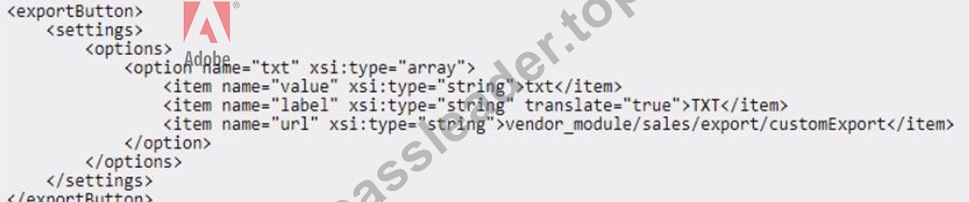
Upon testing, they are getting redirected, what would be a cause for this error?
- A. The option's uri attribute is not valid.
- B. The layout cache needs to be refreshed.
- C. The developer has to add a formkey for the new export option.
Answer: C
Explanation:
The developer has to add a formkey for the new export option because the formkey is required for security reasons. Without the formkey, the request will be rejected and redirected to the dashboard page. Verified References: [Magento 2.4 User Guide] [Magento 2.4 DevDocs] When adding custom export options to grids in Magento, it's crucial to include a form key for actions that involve form submission. Magento relies on form keys for CSRF (Cross-Site Request Forgery) protection, so omitting the form key can lead to redirects or failed operations.
* Form Key Requirement:
* In Magento, the form key is a hidden token included in forms to ensure that the request is valid.
This is particularly important for actions that change the state or export data, as it helps prevent unauthorized actions.
* Adding a custom export button triggers a form submission, which requires a valid form key.
Without it, Magento may redirect to a default page or the admin dashboard as a security measure.
* Why Option C is Correct:
* Option C correctly identifies the lack of a form key as the issue. When Magento detects a missing form key in sensitive operations, it defaults to a redirect to maintain security.
* Option A, concerning the URI, is less likely to cause a redirection. Similarly, Option B regarding layout cache would not directly impact CSRF validation, which is the cause of the redirection here.
* Solution:
* Modify the button or form submission logic to include a form key, typically by adding form_key=
{{formKey}} in the URL parameters or within the form data.
NEW QUESTION # 67
A Project Architect needs to add a new developer who needs to be able to push code in an Adobe Commerce Cloud project. No integration with a third-party repository provider is setup.
What two actions would be required to ensure the developer has access? (Choose Two.)
- A. The developer needs to add SSH public key in the Cloud Account dashboard settings
- B. The Adobe Commerce admin user must be created and the developer's SSH public key must be added on their local system
- C. The developer's email must be added under Users in the Cloud Project Web Ul
- D. The developer's SSH public key must be added into a file named ~/.ssh/authorized_keys
Answer: A,C
Explanation:
To ensure the developer has access to push code in an Adobe Commerce Cloud project, the developer's email must be added under Users in the Cloud Project Web UI and the developer needs to add SSH public key in the Cloud Account dashboard settings. The Cloud Project Web UI is a web interface that allows managing and configuring Adobe Commerce Cloud projects and environments. The developer's email must be added under Users to grant them access to the project and assign them a role and permissions. The Cloud Account dashboard settings is a web interface that allows managing and configuring Adobe Commerce Cloud accounts and SSH keys. The developer needs to add SSH public key in the settings to enable secure connection to the project and environments via SSH. Verified References: [Magento 2.4 DevDocs]
NEW QUESTION # 68
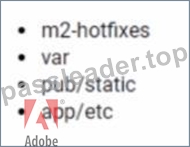
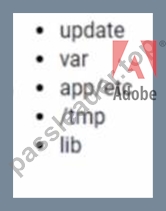
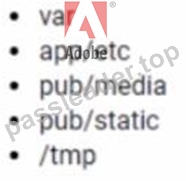
What are the only writeable folders in the application root on a remote Adobe Commerce Cloud project?
- A.
- B.
- C.
Answer: A
Explanation:
For an Adobe Commerce Cloud project, the only writeable folders in the application root on a remote environment are essential for the application to run correctly and store temporary and dynamic data. Among the options given, Option B lists directories that are typically writable:m2-hotfixes,var,pub/static, andapp/etc
. Them2-hotfixesdirectory is specifically for Magento Commerce Cloud and is used for applying hotfixes that are executed during the build phase. Thevardirectory contains various logs, sessions, and reports. Thepub
/staticdirectory holds the compiled static view files, andapp/etccontains configuration files that can be modified by the application at runtime.
NEW QUESTION # 69
A product has been added to the Adobe Commerce Store, and it contains a value for the custom product attribute. A merchant reports that the attribute value is not displayed in the Additional Information tab on the product detail page.
Which action will correct this problem?
- A. The attribute must be moved to the specific group in the attribute set
- B. The attribute property "Use in Product Tab' must be set to "yes"
- C. The attribute property "Visible on Catalog Pages on Storefront" must be set to "yes".
Answer: C
Explanation:
The "Visible on Catalog Pages on Storefront" attribute property determines whether or not the attribute value is displayed in the Additional Information tab on the product detail page. If this property is set to "no", the attribute value will not be displayed.
For a custom product attribute to be displayed in the Additional Information tab on the product detail page in Magento, it needs to be visible on the catalog pages on the storefront. This visibility is controlled by the attribute property "Visible on Catalog Pages on Storefront". When this property is set to "yes", Magento includes the attribute in the Additional Information tab, making it visible to customers browsing the product.
This setting ensures that only relevant and intended attributes are shown on the storefront, allowing for better product information management and customer experience.
NEW QUESTION # 70
An Adobe Commerce developer is tasked with creating a custom block that will be displayed on every page in the footer of the site.
After completing and optimizing the development, the developer notices that the block takes too much time to be generated on each page and decides to store it in the system cache after enabling it for all cache groups.
What would be the minimum requirement to achieve this?
- A. Set values for both cache_lifetime and cache_key data properties of the block.
- B. Set a value for cache_key data property of the block.
- C. Set a value for the cache_Lifetime data property of the block.
Answer: C
NEW QUESTION # 71
Which action, if any, can be taken to change the URL key of the product?
- A. The product URL key is generated automatically, so it cannot be changed.
- B. Use URL rewrite to map product id with the custom URL key.
- C. In the product admin form, under the Search Engine Optimization fieldset, the URL key can be set
Answer: C
Explanation:
The URL key of a product is the text that is used to generate the product's URL. This text can be set by the merchant in the product admin form.
The URL key of a product in Adobe Commerce can be changed in the product admin form under the "Search Engine Optimization" fieldset. Here, the URL key can be set or edited manually, allowing for customization beyond the automatically generated value. This field is typically used to ensure that the product URL is search-engine friendly and relevant to the product.
NEW QUESTION # 72
An Adobe Commerce developer has installed a module from a third-party vendor. This module fires a custom event named third_party_event_after and also defines an observer named third_party_event_after_observer that listens to that event. The developer wants to listen to this custom event in their own module but wants to execute their observer's logic after the third_party_event_after_observer observer has finished executing.
What would the developer do to ensure their observer runs after the observer defined by the third-party module?
- A. Ensure the third-party module is listed in the <sequence> node of the developer's module.xmi file.
- B. Set the sort order of the new observer to be less than that of the third-party vendor's observer.
- C. This is not possible as observers listening to the same event may be invoked in any order.
Answer: C
Explanation:
https://developer.adobe.com/commerce/php/best-practices/extensions/observers/#do-not-rely-on-invocation- order
NEW QUESTION # 73
A developer is creating a class \Vendor\Module\Model\MyModeL How should that class be defined as transient in di.xml?
- A. <type name="\Vendor\Module\Model\MyModer singleton='false7>
- B. <type name='\Vendor\Module\Model\MyModer shared="false7>
- C. <type name="\Vendor\Module\Model\MyModer transient="true7>
Answer: B
Explanation:
To define a class as transient in Magento'sdi.xml, the correct approach is to set thesharedattribute to "false" for that class. This tells Magento's object manager not to use the singleton pattern for this class, meaning a new instance will be created each time the class is requested. This is particularly useful for classes that should not maintain state across different areas of the application or during a single request lifecycle.
NEW QUESTION # 74
Which is a correct CMS content element in Adobe Commerce?
- A. Sheet
- B. Image
- C. Widget
Answer: C
Explanation:
A widget is a CMS content element that can be used to display dynamic content on a page. Widgets can be used to display things like product reviews, social media feeds, or even custom content.
In Adobe Commerce, widgets are a correct CMS content element. Widgets allow merchants to add dynamic data or content blocks to CMS pages, static blocks, and various other locations throughout the store's layout without needing to directly edit the site's code. Options B (Sheet) and C (Image) are not recognized CMS content elements in the context of Adobe Commerce's terminology, making option A the correct answer.
NEW QUESTION # 75
On an Adobe Commerce Cloud platform, what type of environment will be provisioned when launching the CLI for Commerce command magento-cloud environment:branch <environment-name> <parent-environment- id>?
- A. An empty integration environment without any code or database.
- B. An integration environment with fresh Adobe Commerce Cloud installation.
- C. An integration environment with the code and database from the parent environment.
Answer: C
Explanation:
The type of environment that will be provisioned when launching the CLI for Commerce command magento- cloud environment:branch <environment-name> <parent-environment-id> is an integration environment with the code and database from the parent environment. Integration environments are temporary environments that are used for testing and development purposes on the Adobe Commerce Cloud platform. They can be created from any branch of code and have their own dedicated database and services. When creating an integration environment using the CLI for Commerce command, the code and database from the parent environment are copied to the new integration environment, creating an exact replica of the parent environment. Verified References: [Magento 2.4 DevDocs]
NEW QUESTION # 76
How should a record be removed from a database which is using a model that was inherited from the
\Magento\Framework\Model\AbstractModel class?
- A. Call the "remove" method on this model object
- B. Call the "delete" method on this model object
- C. Call the "unset" method on this model object
Answer: B
Explanation:
The "delete" method on the\Magento\Framework\Model\AbstractModelclass is used to remove a record from the database. This method will also cascade the delete to any related records.
In Magento, models that inherit from the\Magento\Framework\Model\AbstractModelclass interact with the database through the ORM (Object-Relational Mapping) layer. To remove a record from the database using such a model, thedeletemethod is used. This method encapsulates the logic for deleting the record associated with the model instance from its corresponding database table. By calling$model->delete(), where$modelis an instance of a model inheriting fromAbstractModel, Magento will perform the necessary operations to remove the record from the database, ensuring data integrity and consistency within the application.
NEW QUESTION # 77
......
Ultimate Guide to Prepare AD0-E724 Certification Exam for Adobe Commerce: https://examcertify.passleader.top/Adobe/AD0-E724-exam-braindumps.html