

Nokia 4A0-112 Exam Info and Free Practice Test | PassLeader
Pass Nokia 4A0-112 Premium Files Test Engine pdf - Free Dumps Collection
NEW QUESTION # 13
There are several differences between IS-IS Hello packets used on broadcast interfaces and on point-to-point interfaces.
Which of the following statements is FALSE?
- A. On broadcast interfaces there are different Hello packet types for level-1 and level-2 adjacencies, whereas on point-to-point interfaces there is a single Hello packet type.
- B. Broadcast Hello messages identify the elected designed IS (DIS) and point-to-point Hello messages do not.
- C. The neighbors are identified using their interface MAC addresses on broadcast Hello messages and using their system IDs on point-to-point Hello messages.
- D. The multicast MAC addresses to which the Hello messages are sent are different on broadcast interfaces and on point-to-point interfaces.
Answer: C
Explanation:
In both broadcast and point-to-point interfaces, IS-IS routers identify neighbors using system IDs, not interface MAC addresses. The system ID is a unique identifier assigned to each router, and it is used to identify neighbors in both types of interfaces.
NEW QUESTION # 14
Refer to the exhibit.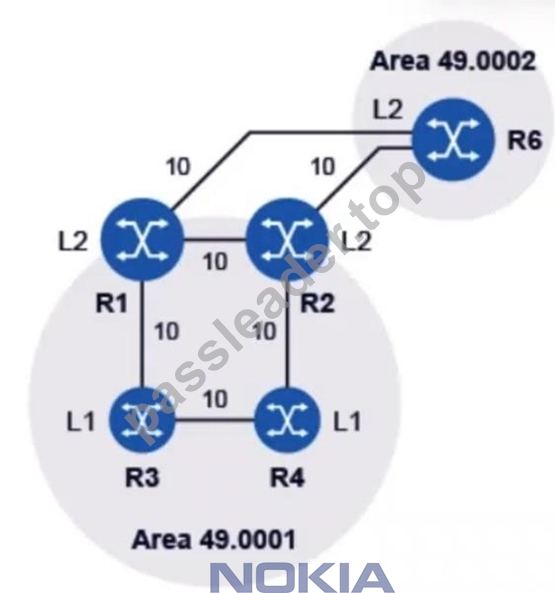
Examine the physical topology of the IS-IS network, the metrics of the links and the levels of the routers. All routers have their system interfaces included in IS-IS. Which of the following statements describes the route-table entry that router R4 will use to reach the system IP address of router R6?
- A. Router R4 will not have a matching entry in its routing table for router R6's system IP address.
- B. Router R4 will have a default route with router R2 as the next-hop.
- C. Router R4 will have a route to router R6's system IP address with router R2 as the next-hop.
- D. Router R4 will have a default route with router R3 as the next-hop.
Answer: C
Explanation:
Router R4 is in Area 49.0001 and R6 is in Area 49.0002. Both routers are Level 2 (L2), meaning that they can communicate across areas using Level 2 IS-IS routing.
Since R2 is the L1/L2 router that connects both Area 49.0001 and Area 49.0002, it will be the next-hop for router R4 to reach R6's system IP address.
The IS-IS protocol will ensure that R4 will have a route to R6's system IP address via R2 as the next-hop.
NEW QUESTION # 15
Which of the following is NOT a function of the control plane a router?
- A. To utilize the forwarding tables to forward data packets towards their destination.
- B. To determine the best way to forward packets.
- C. To exchange signaling messages with other routers.
- D. To establish routing paths to deliver packets from source to destination and to reestablish them in case of failure.
Answer: A
Explanation:
The data plane (or forwarding plane) is responsible for actually forwarding the data packets. It uses the information stored in the forwarding table to determine how to move packets from one interface to another toward their destination.
NEW QUESTION # 16
A router running a link-state routing protocol detects that one of its neighbors is no longer connected to it. The router generates a new link-state advertisement to inform other routers of the topology change. Which of the following is NOT an action that is triggered by this event?
- A. If a router receives the new link-state advertisement, it acknowledges it, stores it, and forwards it to its own neighbors.
- B. If a router receives multiple copies of the new link-state advertisement, it will simply ignore all copies received after the first one.
- C. Every router that receives the new link-state advertisement updates its age field before forwarding it.
- D. Every router that receives the new link-state advertisement runs the SPF algorithm to recalculate its shortest-path tree and its forwarding database.
Answer: C
Explanation:
When a router receives a link-state advertisement (LSA), it does not update the age field before forwarding it. The age field in an LSA is typically updated by the originating router or during the process of forwarding the LSA within the network. Routers do not modify the age field upon receiving and forwarding an LSA.
NEW QUESTION # 17
Refer to the exhibit.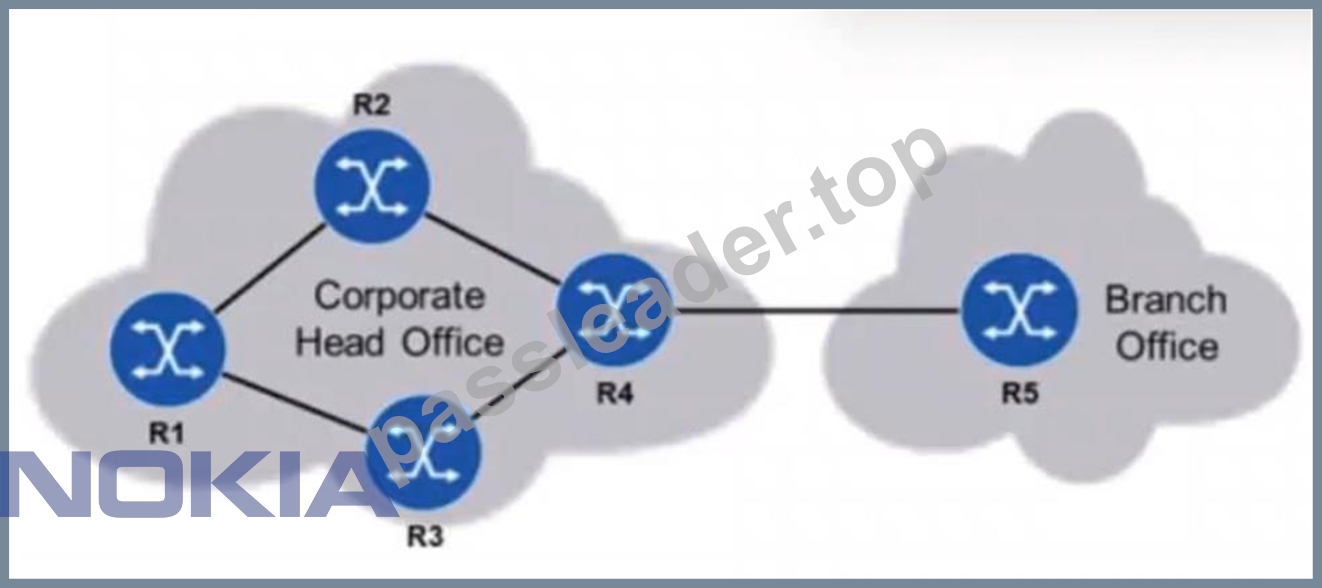
Static routing is to be used in a network between a corporate head office and a branch office. The head office has many connected subnetworks, whereas the branch office has one subnetwork and a single connection to the head office. Which of the following is the most likely configuration on the head office and branch office routers?
- A. The head office and the branch offices both have specific static routes.
- B. The head office and the branch office both have default routes.
- C. The head office has a default route and the branch office has a specific static route.
- D. The head office has a specific static route and the branch office has a default route.
Answer: C
Explanation:
The head office has many connected subnetworks, so it will typically have a default route to forward traffic to the branch office (or external networks), since it may not need to define static routes for each branch network.
The branch office, which has only one subnetwork and a single connection to the head office, will have a specific static route to reach the head office subnet or other subnets at the head office, since it only needs to know the specific route to reach the head office's network.
NEW QUESTION # 18
Which of the following statements about router interfaces on a Nokia 7750 SR is FALSE?
- A. They can be logical or physical.
- B. They can be used in pairs on the same subnet for redundancy.
- C. The system interface exists by default.
- D. They can be assigned IPv4 and/or IPv6 addresses.
Answer: B
Explanation:
Typically, interfaces on a Nokia 7750 SR router are not configured in pairs on the same subnet for redundancy. Instead, redundancy is achieved through mechanisms like Virtual Router Redundancy Protocol (VRRP) or other high availability protocols, not by simply using interfaces in pairs on the same subnet.
NEW QUESTION # 19
Refer to the exhibit.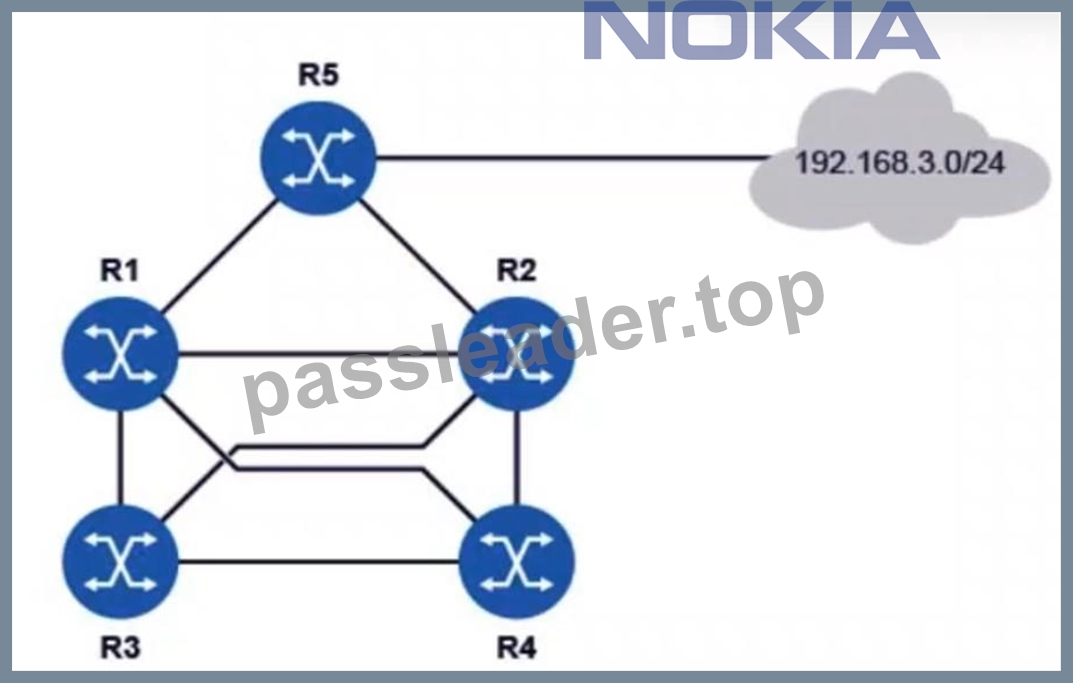
All routers in the diagram are running an interior gateway protocol (IGP) and have been configured with an ECMP value of 4. Router R5 advertises the prefix 192.168.3.0/24 using the IGP. Assuming all links have the same cost, how many entries for prefix 192.168.3.0/24 will be in router R3's routing table?
- A. 0
- B. 1
- C. 2
- D. 3
Answer: B
Explanation:
In this scenario, the routers are configured with an Equal-Cost Multi-Path (ECMP) value of 4, meaning they can utilize up to 4 equal-cost paths to reach a destination. Since Router R5 is advertising the 192.168.3.0/24 prefix and all links have the same cost, router R3 will receive multiple routes to reach this destination.
Given that all the routers (R1, R2, R3, R4, and R5) are connected in a way that can support multiple equal-cost paths, and assuming ECMP is set to 4, the routing table on Router R3 will have up to 4 entries for the prefix 192.168.3.0/24.
Thus, Router R3's routing table will contain 4 entries for the prefix 192.168.3.0/24.
NEW QUESTION # 20
Refer to the exhibit.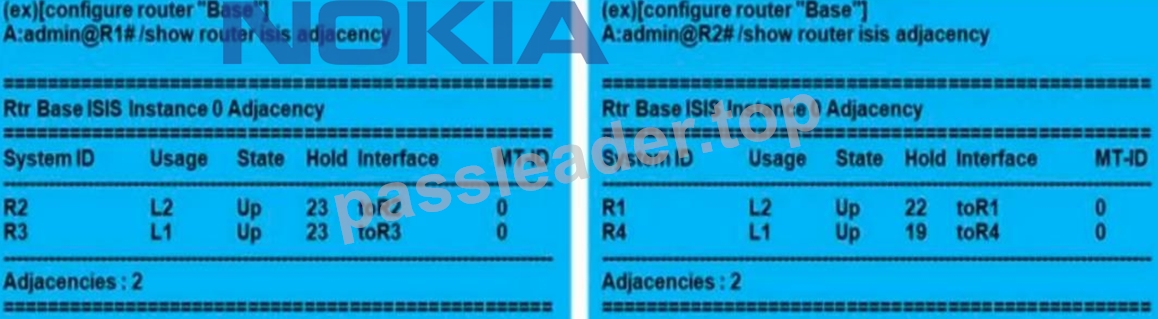
Routers R1, R2, R3, and R4 are running IS-IS. Assuming all interfaces are added to IS-IS as point-to-point and no commands are issued at the interface level to restrict adjacencies, which of the following statements is TRUE?
- A. All four routers are L1/L2.
- B. Routers R1 and R2 are L1/L2 routers. Routers R3 and R4 are L1 routers.
- C. Routers R1 and R2 are L2 routers. Routers R3 and R4 are L1/L2 routers.
- D. Routers R1 and R2 are L2 routers. Routers R3 and R4 are L1 routers.
Answer: B
Explanation:
From the output, we can see that the usage column indicates whether a router is operating as an L1 or L2 router:
The L1/L2 designations refer to whether the routers participate in both Level 1 and Level 2 of IS-IS:
In this case, R1 and R2 are L2 routers, and R3 and R4 are L1 routers.
NEW QUESTION # 21
When using IS-IS in native mode for routing in a dual-stack IPv4/IPv6 environment, which of the following statements is FALSE?
- A. It may lead to traffic black-holing if not properly designed.
- B. In a multi-area environment, the SPF algorithm needs to be run four times on each L1/L2 router.
- C. All links are assumed to be IPv4- and IPv6-capable.
- D. The same topology information is used to calculate the shortest path tree for both IPv4 and IPv6.
Answer: B
Explanation:
In a dual-stack IPv4/IPv6 IS-IS environment, the SPF (Shortest Path First) algorithm is only run once per router for each protocol (IPv4 or IPv6). The topology is shared, but the SPF calculations for IPv4 and IPv6 are separate. This means that the SPF algorithm will run twice (once for IPv4 and once for IPv6) for each L1/L2 router, not four times.
NEW QUESTION # 22
Refer to the exhibit.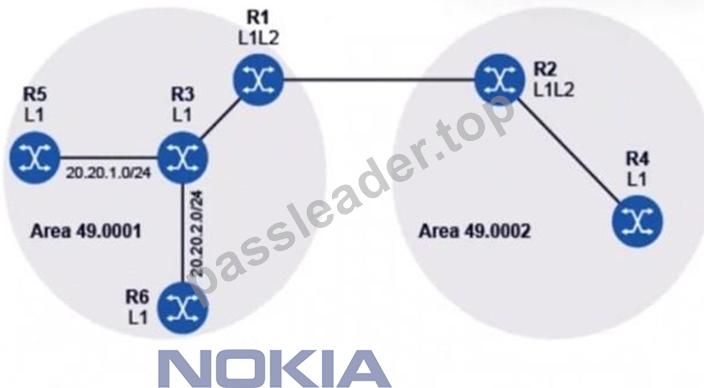
In the IS-IS network shown, router R1 has been configured to summarize subnetworks 20.20.1.0/24 and 20.20.2.0/24 as 20.20.0.0/16. Which routers' routing tables will be reduced, compared to their routing tables before the summarization?
- A. Router R1
- B. Router R2
- C. Routers R1 and R2
- D. Routers R2 and R4
Answer: B
Explanation:
Router R1 is the one that performs the summarization of the two subnets (20.20.1.0/24 and 20.20.2.0/24) into the summarized route 20.20.0.0/16. However, R1 itself will not see any change in its routing table because it is directly connected to both subnets and already knows about them.
Router R2, which is in Area 49.0002, will benefit from this summarization because it previously had separate routes for both 20.20.1.0/24 and 20.20.2.0/24. After the summarization, R2 will only need to maintain a single route to 20.20.0.0/16, reducing the size of its routing table.
Router R4 does not directly benefit from the summarization because it is only connected to the Level 1 network and has no need for the summarized routes from R1. Thus, the summarization does not affect R4's routing table.
NEW QUESTION # 23
An IS-IS router receives a CSNP that references an older LSP than the one in its local database. What action is taken?
- A. The router sends a copy of the referenced LSP from its database to its neighbor.
- B. The router updates its database with the new sequence number and floods a copy of the LSP to its other neighbors.
- C. The router sends a PSNP to its neighbor to request a copy of the LSP.
- D. The router sends a CSNP to its neighbor describing the newer LSPs in its database.
Answer: A
Explanation:
When a router receives a CSNP (Complete Sequence Number PDU) that references an older LSP (Link-State PDU) than the one in its local database, it indicates that the neighbor is missing newer information.
In response, the router sends back a PSNP (Partial Sequence Number PDU) to the neighbor, which includes a copy of the LSPs it has in its local database that the neighbor may not yet have. This helps to synchronize the link-state information between routers.
NEW QUESTION # 24
A router is trying to establish an IS-IS adjacency with the DIS on a broadcast link. What event causes the adjacency to change from "Initializing" to "UP"?
- A. Receiving the last LSP requested from the DIS.
- B. Receiving a Hello packet from the DIS that contains the local router's own MAC address in the neighbor list.
- C. Receiving the first CSNP packet from the DIS that lists the LSPs in the DIS's link-state database.
- D. Receiving a CSNP packet from the DIS acknowledging the last transmitted LSP.
Answer: C
Explanation:
The process of establishing an IS-IS adjacency on a broadcast link involves several steps, and the transition from the Initializing state to the UP state occurs when both routers exchange sufficient information to confirm they have a consistent view of the link-state database.
The CSNP (Complete Sequence Number PDU) packet is used to advertise the list of LSPs in the router's link-state database. When a router receives the first CSNP from the DIS (Designated Intermediate System) that lists the LSPs in the DIS's database, it indicates that the router has enough information to establish the adjacency and synchronize its database.
NEW QUESTION # 25
When multiple routing protocols offer a route for the same prefix, what part of the router is in charge of deciding which route to make active?
- A. The routing information base (RIB)
- B. The forwarding information base (FIB)
- C. The routing table manager (RTM)
- D. The equal cost multipath configuration
Answer: C
Explanation:
The routing table manager (RTM) is responsible for selecting the best route when multiple routing protocols provide a route for the same destination prefix. It makes the decision on which route to add to the routing table based on the administrative distance, metric, and other criteria.
NEW QUESTION # 26
Which of the following definitions best describes route redistribution?
- A. It is the process of controlling which route advertisements received from routing peers are accepted and/or deciding which locally known prefixes are advertised to routing peers.
- B. It is the process of passing routing information from one routing domain to another, which usually means from one routing protocol to another.
- C. It is the process of deciding at line-rate speed which packets will be dropped and which ones will be forwarded.
- D. It is the process of redirecting packets to be processed by an intermediate network function before allowing them to be forwarded to their intended final destination.
Answer: B
Explanation:
Route redistribution is the process of sharing routing information between different routing protocols or routing domains. For example, a router might redistribute routes learned via OSPF into a BGP routing table or vice versa. This enables routers to exchange routing information even when they are using different routing protocols.
NEW QUESTION # 27
On a broadcast interface, an IS-IS router receives an LSP that is newer than the one on its database. Which of the following statements best describes the actions taken by the router as a consequence?
- A. The router sends back a copy of the LSP from its database to its neighbor.
- B. The router updates its database with the LSP and acknowledges it with a PSNP.
- C. The router updates its database with the LSP and floods a copy to its neighbors on other interfaces.
- D. The router updated its database with the LSP, acknowledges the LSP with a PSNP, and floods a copy to its neighbors on other interfaces.
Answer: D
Explanation:
When an IS-IS router receives a newer LSP (Link-State PDU) than the one already in its database, it takes the following actions:
Updates its link-state database with the new LSP.
Acknowledges the LSP with a PSNP (Partial Sequence Number PDU), which is sent to the router that originated the LSP, confirming the receipt of the newer LSP.
Floods a copy of the updated LSP to its neighbors on other interfaces to ensure all routers in the network have the updated topology information.
NEW QUESTION # 28
A routing domain is using a single-area link-state routing protocol. Which of the following is NOT information that a router can share with other routers in the domain using protocol-specific messages?
- A. A copy of the local routing table.
- B. The IP prefixes of subnets directly attached to the router.
- C. IP prefixes known by the router because it is running ad additional routing protocol.
- D. The local router ID and the router IDs of neighboring routers.
Answer: A
Explanation:
In a single-area link-state routing protocol (such as OSPF), routers share specific information about the network topology, not their entire routing table. They exchange link-state advertisements (LSAs) that contain information about their directly connected interfaces and their state, allowing other routers to build a consistent view of the network.
NEW QUESTION # 29
Two IS-IS routers are exchanging Hello packets. One is configured to use authentication and the other is not. Which of the following statements is TRUE?
- A. An adjacency will be established with authentication using the default parameters defined for IS-IS routers.
- B. An adjacency will not be established.
- C. An adjacency will be established without authentication.
- D. The two routers will negotiate the authentication parameters and the establish an adjacency.
Answer: B
Explanation:
IS-IS routers must have matching authentication settings to establish an adjacency. If one router is configured with authentication and the other is not, the routers will not be able to establish an adjacency because their authentication parameters do not match.
NEW QUESTION # 30
......
Updated Official licence for 4A0-112 Certified by 4A0-112 Dumps PDF: https://examcertify.passleader.top/Nokia/4A0-112-exam-braindumps.html