

A Fully Updated 2026 SecOps-Pro Exam Dumps - PDF Questions and Testing Engine
Easy Success Palo Alto Networks SecOps-Pro Exam in First Try
NEW QUESTION # 24
A SOC analyst is investigating a series of suspicious outbound connections from an internal server to an unknown IP address on port 4444. The SIEM has flagged this activity as 'High' severity. What is the most effective initial course of action for the analyst, prioritizing containment and data gathering?
- A. Isolate the compromised server from the network, initiate a memory dump, and then analyze network flow data.
- B. Notify executive leadership about the high-severity alert and await further instructions.
- C. Immediately block the outbound IP address at the firewall and then begin log analysis.
- D. Initiate a full packet capture on the network segment containing the server to understand the payload, and simultaneously check threat intelligence feeds for the destination IP.
- E. Review all historical logs from the server and firewall for similar connections before taking any action.
Answer: D
Explanation:
While isolation (B) is a strong containment measure, initiating a packet capture (D) is crucial for understanding the nature of the communication without immediately disrupting it, providing vital forensic data. Simultaneously checking threat intelligence feeds allows for immediate context. Blocking (A) without understanding could be premature or disrupt legitimate business processes if it's a false positive, though less likely in this scenario. Reviewing historical logs (C) is part of investigation but not the most effective initial action for an active high-severity alert. Notifying leadership (E) is important but comes after initial triage and data gathering.
NEW QUESTION # 25
A threat intelligence team produces a report on a new APT group known for targeting specific industry sectors using novel obfuscation techniques. This report includes IOCs (Indicators of Compromise) and TTPs (Tactics, Techniques, and Procedures). How should this intelligence be integrated into an organization's incident categorization and prioritization process to maximize its impact?
- A. The IOCs should be immediately blocked at the firewall, and the TTPs added to a static incident classification matrix.
- B. Only the IOCs should be ingested into the SIEM as watchlists, and TTPs should be ignored as they are too abstract for direct prioritization.
- C. The report should be circulated to all IT staff for awareness, and any alerts matching the IOCs should be manually reviewed daily.
- D. The IOCs should be used to create new detection rules with a 'Critical' severity, and the TTPs should inform playbooks and analyst training for identifying related behavioral anomalies and dynamically assigning higher priority to incidents matching these TTPs.
- E. The intelligence should primarily be used for retrospective hunting exercises and not directly integrated into real-time categorization.
Answer: D
Explanation:
Integrating threat intelligence effectively means leveraging both IOCs and TTPs. IOCs (like hashes, IPs, domains) are excellent for creating specific, high-fidelity detection rules (Option B), which can be automatically assigned a high severity due to the known threat actor. TTPs, being behavioral patterns, are crucial for informing and refining incident categorization and prioritization beyond just IOC matches. By understanding the APT group's TTPs, security teams can: 1) Create more sophisticated detection logic in the SIEM/EDR, 2) Develop or modify XSOAR playbooks to look for combinations of events that align with these TTPs, and 3) Train analysts to recognize these behaviors, allowing them to dynamically assign higher priority to incidents exhibiting these characteristics, even if no explicit IOCs are present. This holistic approach significantly improves detection and response capabilities.
NEW QUESTION # 26
An advanced XSOAR user is developing a new content pack designed for highly sensitive internal security operations. This pack includes custom integrations, automations, and playbooks that handle confidential company dat a. They need to ensure that this pack remains strictly internal, is version-controlled, can be deployed consistently across a limited number of production XSOAR instances, and undergoes internal quality gates before deployment, without any exposure to the public or the Cortex XSOAR Marketplace public repository. Which of the following XSOAR features and architectural patterns should be employed to meet these requirements? (Select all that apply)
- A. Employ XSOAR's 'Bridge' integration to connect to a separate, air-gapped development XSOAR instance for content staging and testing before manual deployment to production.
- B. Store the source code of the custom content pack in an internal Git repository (e.g., GitLab, GitHub Enterprise) for version control and collaborative development.
- C. Publish the pack to the 'Community' section of the XSOAR Marketplace but mark it as 'private' to restrict access. (Incorrect: There is no 'private' marking for community packs in the public marketplace.)
- D. Utilize XSOAR's 'Private' pack type when creating the content. This ensures the pack is only visible and manageable within the organization's XSOAR instances.
- E. Leverage a CI/CD pipeline (e.g., Jenkins, GitHub Actions) to automate testing, build, and deployment of the custom pack to designated XSOAR instances, ensuring consistent deployments and quality gates.
Answer: B,D,E
Explanation:
To meet the stringent requirements for highly sensitive, internal-only content, the following XSOAR features and architectural patterns are crucial:
A). Utilize XSOAR's 'Private' pack type: This is fundamental for ensuring the pack is strictly internal and never exposed to the public Marketplace. Private packs are managed directly within an organization's XSOAR environment.
B). Store the source code in an internal Git repository: Version control is essential for managing changes, collaborating among developers, and rolling back to previous versions if needed. An internal Git repository provides the necessary security and control for sensitive code.
C). Leverage a CIICD pipeline: Automating testing, building, and deployment via a CI/CD pipeline ensures consistency, reduces human error, and allows for the enforcement of quality gates (e.g., code reviews, automated tests) before deployment to production instances.
D). Publish to 'Community' and mark 'private': This is incorrect. There is no such 'private' marking for packs published to the public Community Marketplace. Once published there, they are generally accessible.
E). Employ XSOAR's 'Bridge' integration to connect to a separate, air-gapped development XSOAR instance: While a separate development instance is a good practice for testing, using 'Bridge' specifically for content staging and testing before manual deployment isn't the primary method for automated, version-controlled distribution across multiple production instances, nor does 'Bridge' inherently provide air- gapped security for content itself. The CI/CD approach (Option C) is more robust for deployment consistency.
NEW QUESTION # 27
A security analyst is investigating a suspected data exfiltration incident. The attacker is believed to have compromised an internal web server and is using a novel, encrypted C2 channel to exfiltrate sensitive database backups. The web server is instrumented with a Cortex XSIAM Host Sensor, and the network segment has a Cortex XSIAM Network Sensor deployed. Which specific data elements from these two sensor types would be most critical for identifying the exfiltration and understanding the C2 channel, and what analysis techniques would be applied?
- A. From the Host Sensor: Antivirus scan logs and firewall rules. From the Network Sensor: Unencrypted HTTP traffic and well-known port scans. Analysis: Check for malware alerts and standard attack patterns.
- B. From the Host Sensor: Login attempts and user activity logs to detect compromised credentials. From the Network Sensor: DHCP lease assignments and ARP table entries to map network topology. Analysis: Focus on user behavior analytics for anomalies.
- C. From the Host Sensor: Installed software inventory and patch levels. From the Network Sensor: SNMP traps and syslog messages from network devices. Analysis: Identify vulnerabilities and configuration weaknesses.
- D. From the Host Sensor: Process execution logs and file access records to identify the process initiating the exfiltration. From the Network Sensor: DNS queries and TLS handshake metadata to identify the C2 domain and certificate details. Analysis: Correlate host-level process activity with suspicious external network connections.
- E. From the Host Sensor: System uptime and hardware utilization metrics to detect performance degradation. From the Network Sensor: ICMP echo requests and responses to map network reachability. Analysis: Look for resource consumption spikes indicating large file transfers.
Answer: D
Explanation:
To identify data exfiltration and understand an encrypted C2 channel: 1. Host Sensor: Crucial for understanding the 'who' and 'what' on the endpoint. Process execution logs would show which process initiated the database backup and subsequent network connections. File access records would confirm the creation or modification of the backup file. 2. Network Sensor: While the C2 channel is encrypted, the Network Sensor can still provide critical metadata. DNS queries reveal the C2 domain name (even if the subsequent traffic is encrypted). TLS handshake metadata (e.g., SNI, certificate details, JARM hashes) can help identify the C2 server's identity or characteristics, even without decrypting the payload. Analysis involves correlating the suspicious process activity on the host with the external network connections observed by the network sensor, looking for connections to newly observed or suspicious domains/IPs, especially those occurring around the time of data access or modification.
NEW QUESTION # 28
A sophisticated attacker has bypassed initial perimeter defenses and is attempting to establish persistence on an endpoint managed by Cortex XDR by modifying system files and disabling security services. The security team has defined a 'Tier 1 Analyst' role in Cortex XDR, primarily for alert triage, and a 'Tier 2 Analyst' role for deeper investigations and remediation. Which of the following Cortex XDR features and operational considerations are critical for the 'Tier 1 Analyst' to effectively escalate and the 'Tier 2 Analyst' to remediate this threat, while ensuring compliance with internal security policies?
- A. Tier 1: Validate the alert severity against the compliance framework. Tier 2: Manually log into the compromised endpoint to perform remediation steps, then update the XDR incident with a summary of actions, which is sufficient for audit.
- B. Tier 1: Forward the alert to an external managed security service provider (MSSP). Tier 2: Wait for MSSP's guidance, then apply a predefined 'compliance lockdown' policy in XDR to prevent any user interaction with the endpoint.
- C. Tier 1: Identify alerts from behavioral threat prevention (BTP) and malware prevention. Tier 2: Utilize Live Terminal for immediate file restoration, apply a 'quarantine endpoint' action, and escalate to C-level management for compliance sign-off.
- D. Tier 1: Review XDR incident details for correlated alerts (e.g., 'Attempted Service Stop', 'File Tampering'). Tier 2: Initiate a forensic disk image acquisition using XDR's capabilities, apply a policy override to prevent further modifications, and use Response Actions like 'Kill Process' and 'Delete File' via XDR Console, ensuring all actions are logged for audit and compliance.
- E. Tier 1: Close the incident if no immediate data loss is detected. Tier 2: Re-deploy the Cortex XDR agent to ensure all security services are re-enabled, relying on the agent's self-healing for compliance.
Answer: D
Explanation:
For such a sophisticated attack, 'Tier 1 Analyst' needs to quickly identify correlated alerts from Cortex XDR's behavioral analytics. The 'Tier 2 Analyst' then requires powerful remediation capabilities directly from the Cortex XDR console to minimize dwell time. This includes forensic acquisition for detailed analysis, policy overrides for immediate containment, and precise response actions (Kill Process, Delete File). Crucially, all these actions performed within Cortex XDR are automatically logged, providing an auditable trail essential for compliance with internal security policies and regulatory requirements. Manual intervention (Option C) is less efficient and harder to audit consistently.
NEW QUESTION # 29
A critical zero-day vulnerability is publicly disclosed in a widely used web server. Your organization's incident response plan dictates immediate action to identify potential exploitation attempts. You have Palo Alto Networks NGFWs, access to WildFire, and subscribe to Unit 42 threat intelligence. Furthermore, your team frequently uses VirusTotal for initial reconnaissance. To swiftly identify and contain potential exploitation attempts, which of the following combined strategies offers the best immediate response capability and long-term intelligence gathering?
- A. Proactively blocking all traffic to the affected web server and submitting its logs to VirusTotal for retrospective analysis.
- B. Leveraging Unit 42's rapid vulnerability research and exploit intelligence to identify specific exploit patterns, configuring custom signatures or threat prevention profiles on NGFWs, and using WildFire for any observed suspicious payloads.
- C. Disabling the vulnerable web server entirely until a patch is released, and reviewing historical VirusTotal submissions for any related hashes.
- D. Monitoring public forums and social media for mentions of the vulnerability and applying generic network intrusion detection system (NIDS) rules.
- E. Focusing solely on endpoint detection and response (EDR) alerts, as web server exploitation is primarily an endpoint issue.
Answer: B
Explanation:
A zero-day vulnerability requires immediate, targeted action and deep understanding of potential exploits. Unit 42 excels in rapid vulnerability research and exploit intelligence, often providing detailed analysis of how vulnerabilities are being weaponized in the wild. This intelligence is crucial for creating specific, effective threat prevention rules on NGFWs. WildFire can then be used to analyze any novel payloads or post-exploitation tools observed, providing real-time signatures. This combined approach allows for proactive network-level defense based on expert intelligence and dynamic analysis of new threats.
NEW QUESTION # 30
During a post-incident review, it's discovered that a misconfigured service account (User A) was able to delete critical log files from several endpoints, hindering forensic analysis. This service account's role in Cortex XDR was 'Incident Responder'. Another user (User B) with the 'Security Administrator' role later modified the incident status but had no direct involvement in the log deletion. Analyze the MOST effective immediate and long-term security operations measures within Cortex XDR to prevent similar incidents, specifically focusing on user roles, log management, and data protection.
- A. Revise the 'Incident Responder' role to remove permissions for deleting logs. Enhance log retention policies in Cortex Data Lake and enable audit logging for all administrative actions within Cortex XDR.
- B. Immediately revoke 'User A's' Cortex XDR access. Long-term, implement Data Protection policies to prevent log file deletion by any user role, and configure log forwarding to an immutable external archive.
- C. Isolate all affected endpoints immediately. Deploy a 'deny-all' data protection policy globally and instruct all users to use temporary, time-bound credentials for all Cortex XDR operations.
- D. Implement multi-factor authentication (MFA) for 'User A' and 'User B'. Deploy a new Cortex XDR agent version that includes enhanced tamper protection for log files on endpoints.
- E. Configure a custom alert for 'log file deletion' events. Schedule regular role-based access control (RBAC) audits and integrate Cortex XDR with an external IAM system for centralized user management.
Answer: A
Explanation:
The most effective immediate and long-term solution addresses the root cause: excessive permissions for 'User A's' role. Revising the 'Incident Responder' role to align with the principle of least privilege directly prevents future log deletion. Enhancing log retention in the Cortex Data Lake ensures data availability even if local logs are tampered with. Crucially, enabling audit logging for administrative actions within Cortex XDR provides accountability and traceability for changes made to roles, policies, and incident statuses, including 'User B's' actions, which is vital for compliance and forensic purposes.
NEW QUESTION # 31
A SOC team is utilizing Cortex XDR for endpoint security and incident response. They receive an alert indicating 'Ransomware Activity' on a critical server. Upon initial investigation, Cortex XDR's 'Causality Chain' reveals a legitimate administrative tool (PsExec) was used to move laterally, followed by a PowerShell script executing a suspicious process, and then file encryption. The analyst suspects a 'living off the land' attack. Which of the following Cortex XDR features and subsequent actions would be most effective for a rapid, comprehensive investigation and containment in this scenario, and why?
- A. Leverage the 'XDR Query Language (XQL)' to search for other instances of PsExec usage followed by PowerShell execution across the entire environment. Initiate 'Host Isolation' and then 'Process Termination' for the identified suspicious processes across affected hosts.
- B. Review the 'Incident View' for a high-level summary and then generate a 'Forensic Report' for detailed offline analysis. Then, notify the IT team to reimage the server.
- C. Initiate an automated 'Playbook' in Cortex XSOAR that integrates with Cortex XDR to execute a full memory dump, collect network connections, and automatically block the C2 IP addresses at the firewall.
- D. Use 'Live Terminal' on the affected endpoint to manually check running processes and file system for indicators of compromise (IOCs). Then, quarantine the endpoint.
- E. Utilize 'Application Control' policies to prevent PsExec execution globally, and use 'Disk Encryption' on all critical servers to prevent further file encryption.
Answer: A
Explanation:
This scenario describes a 'living off the land' attack, requiring broad investigation beyond the initial alert to identify the full scope.
1. XQL Query Language (XQL): This is critical for threat hunting across the entire environment. Since PsExec and PowerShell are legitimate tools, simply reacting to one alert is insufficient. XQL allows the analyst to search for the specific sequence of events (PsExec followed by PowerShell execution and file encryption attempts) that indicates malicious activity, identifying if other systems are compromised or targeted.
2. Host Isolation: This is a crucial and rapid containment measure to prevent further lateral movement and encryption, limiting the damage.
3. Process Termination: Immediately stopping the suspicious processes on identified hosts is essential for eradication.
Let's analyze other options:
A: 'Live Terminal' is good for deep dives on a single host, but doesn't scale for a 'living off the land' investigation across the environment. Manual checking is time-consuming.
C: Reviewing 'Incident View' and generating a 'Forensic Report' are important, but do not provide immediate containment or environmental threat hunting capabilities. Reimaging is an eradication step, but without full scope, it might be premature or insufficient.
D: 'Application Control' to prevent PsExec globally could disrupt legitimate operations; a more granular approach is needed. 'Disk Encryption' is a preventative measure, not a direct response to an active ransomware attack.
E: While an XSOAR playbook for automation is excellent for advanced SOCs, the question specifically asks about Cortex XDR features for 'rapid, comprehensive investigation and containment'. XQL provides that comprehensive investigation capability within XDR, and Host Isolation/Process Termination are the immediate containment actions within XDR. A full XSOAR integration might be a later step in a more mature incident response process but isn't the primary XDR feature for this initial scope and containment.
NEW QUESTION # 32
A Security Operations Analyst is reviewing a Cortex XDR incident involving a critical Windows server. The alert indicates 'Local Analysis- Malicious Executable' and 'Behavioral Threat Protection - Ransomware'. Upon initial investigation, it's clear the attacker attempted to execute a known ransomware variant that Cortex XDR successfully blocked. However, the analyst needs to confirm no residual threats exist and collect specific details about the blocked execution attempt, including the full command line, process ancestry, and any related file modifications, without directly accessing the server. What is the most comprehensive and efficient workflow within Cortex XDR to achieve this post-block forensic analysis?
- A. Perform a 'Collect Forensic Data' action on the server to retrieve a full disk image and memory dump, then analyze these artifacts using an external forensic workstation.
- B. Open the 'Incident Timeline' for the specific incident. Examine the 'Causality Chain' graph and the associated raw process events for the ransomware attempt. Use 'XDR Query' to pull specific process and file events using event IDs.
- C. The Cortex XDR agent automatically generates a 'Threat Analysis' report for every blocked threat, which contains all necessary details. Locate and download this report from the 'Threats' tab.
- D. Review the 'Alert' details in the Incidents table for command-line and process information. If insufficient, initiate a 'Live Terminal' session to the server to manually check logs and process history.
- E. Navigate to the 'Endpoint' details page for the affected server, then access the 'Event Log' to filter for relevant 'Execution' and 'Process' events, leveraging the causality chain presented.
Answer: B
Explanation:
For deep post-block analysis of an alert within Cortex XDR, leveraging the built-in incident and endpoint telemetry is key. C: Incident Timeline and Causality Chain: This is the most comprehensive and efficient workflow within Cortex XDR. The 'Incident Timeline' provides a chronological view of all events related to an incident. The 'Causality Chain' is a powerful visualization that maps the relationships between processes, files, and network connections, clearly showing the parent-child relationships, command lines, and actions taken (like process creation, file modifications). Clicking on nodes in the causality chain reveals raw event details. For highly specific data points not immediately obvious, 'XDR Query' (or XQL) allows analysts to construct precise queries against the collected endpoint logs (which include process execution details, file events, etc.) to pull exactly what's needed. This allows for detailed forensic analysis without touching the endpoint. A: Alert details and Live Terminal: Alert details provide some information, but are often summarized. 'Live Terminal' is for active intervention or ad-hoc investigation, not for structured, historical forensic analysis, and directly accessing the server was explicitly excluded by the question. B: Endpoint details and Event Log: While useful, directly navigating the 'Event Log' for an endpoint can be overwhelming for a specific incident analysis. The 'Causality Chain' (Option C) provides a much more focused and intuitive view of the incident's relevant events. D: Collect Forensic Data (full image/memory dump): This is overkill for confirming a blocked execution and collecting specific details. Full disk images and memory dumps are resource-intensive and time-consuming to collect and analyze, typically reserved for deeper, complex investigations where the XDR telemetry is insufficient, or for court-ready evidence. The question asks for efficiency and specific details about the blocked attempt, which XDR's telemetry already provides. E: Threat Analysis report: While Cortex XDR provides significant context, it doesn't automatically generate a standalone 'Threat Analysis' report for every single blocked threat with all the specific details requested. The information is available, but it's distributed within the incident/endpoint telemetry that needs to be navigated, primarily through the causality chain and raw events.
NEW QUESTION # 33
A Palo Alto Networks security architect is explaining the concept of 'AI-driven SecOps' versus 'ML-driven SecOps' to a client. The client, a seasoned SOC manager, challenges the architect, stating, 'Isn't AI just a marketing term for advanced ML models? Give me a concrete scenario where an AI-driven system would demonstrably perform a security task that an ML-only system fundamentally cannot, even with vast amounts of data.' Which of the following scenarios provides the best and most distinct example of AI's unique capability in Security Operations?
- A. An ML system can prioritize alerts based on severity and confidence scores. An AI system can explain its reasoning behind an alert in a human-understandable format, citing specific evidence and correlations, which an ML system typically cannot do inherently.
- B. An ML system can detect polymorphic malware using deep learning. An AI system can autonomously generate polymorphic decoy files and distribute them across the network to trap and analyze new malware strains, effectively acting as an intelligent honey-pot system.
- C. An ML system can detect ransomware by identifying anomalous file encryption patterns. An AI system, by contrast, could predict a ransomware attack before encryption begins by understanding the attacker's T TPs and correlating pre-cursor activities with high confidence, even across a new variant.
- D. An ML system can identify insider threats by detecting deviations from normal user behavior baselines. An AI system could engage in a natural language dialogue with a suspected insider to gather more context, assess intent, and guide them through remediation steps, mimicking a human analyst.
- E. An ML system can classify network traffic as malicious or benign based on learned features. An AI system could autonomously design new security policies and firewall rules in real-time to counter a novel attack, without human intervention or pre-defined templates, by understanding the attack's intent and impact.
Answer: E
Explanation:
This question seeks a scenario where AI demonstrates a fundamental capability beyond even 'advanced ML with vast data.' Option A describes predictive analytics, which, while sophisticated, is still largely within the realm of advanced ML. ML models can learn to predict based on patterns. Option C describes Natural Language Processing/Understanding, which is an AI field, but the 'dialogue' part is often a specific application of NLP, not a fundamental differentiation of all AI beyond all ML in general security operations. Also, 'guiding through remediation' can be script-driven. Option D describes explainable AI (XAI), which is a crucial aspect of modern AI, but the core 'detection' or 'action' is still often rooted in ML. Explanations can be built on top of ML outputs. Option E describes a highly advanced, research-oriented AI capability (generative AI for defense/deception) which is cutting-edge but not yet a widespread, core 'security operations' task that all AI systems perform and ML fundamentally cannot. It's an application of AI, but perhaps not the most fundamental distinction for the general concept. Option B represents a truly fundamental leap. The ability to autonomously design new, context-aware security policies and firewall rules based on understanding attack intent and impact, without relying on pre-programmed templates or human intervention (beyond the initial 'learning' phase), crosses the boundary from pattern recognition (ML) to cognitive, creative problem-solving and autonomous decision-making in a novel situation, which is a hallmark of strong AI. An ML-only system can classify or detect, but it doesn't 'design' new rules or policies in a truly autonomous and adaptive way.
NEW QUESTION # 34
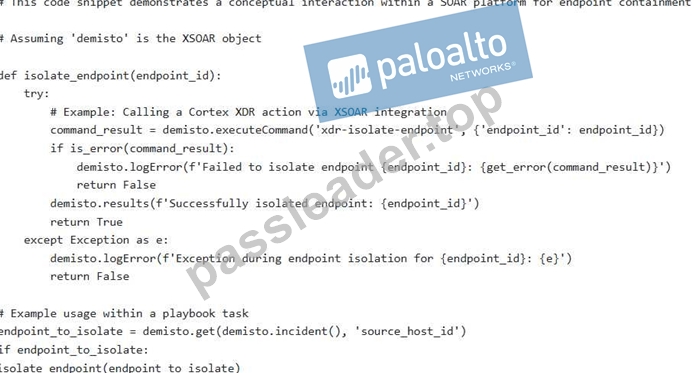
A SOC is migrating from a traditional SIEM to a cloud-native Security Operations Platform, specifically evaluating the integration capabilities of Palo Alto Networks Cortex XSOAR. The primary objective is to automate repetitive incident response tasks, such as enriching alerts with threat intelligence, containing compromised endpoints, and generating incident reports. Which of the following Python code snippets, when integrated into a custom playbook in Cortex XSOAR, would exemplify the automation of enriching an alert with threat intelligence from a external API, assuming 'demisto' is the global object for XSOAR functions and 'incident' is the current incident object?
- A.
- B.
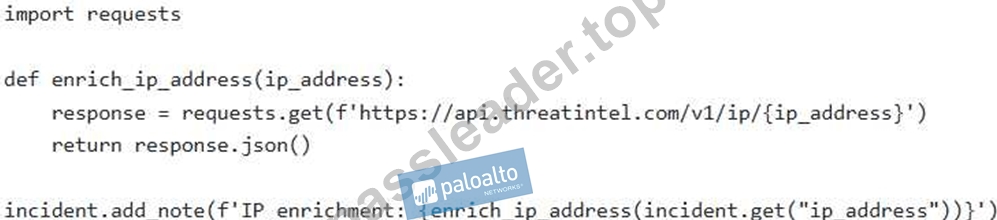
- C.

- D.

- E.
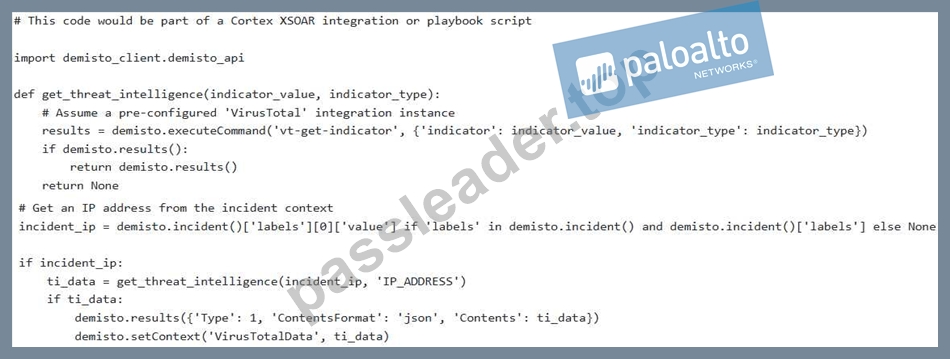
Answer: A,E
Explanation:
This is a multiple-response question requiring knowledge of SOAR automation and Palo Alto Networks XSOAR specifics. Option C (Correct): This snippet correctly demonstrates how a Python script within Cortex XSOAR (using 'demisto.executeCommand') would call a pre-configured integration (e.g., VirusTotal) to enrich an indicator, then 'demisto.resultS and 'demisto.setContext' to make the data available within the incident. This directly addresses the 'enriching alerts with threat intelligence' part of the question. Option E (Correct): This snippet correctly demonstrates how XSOAR would be used to automate the 'containing compromised endpoints' task by calling an action from an integrated EDR solution (like Cortex XDR) via This is a core SOAR capability. Option A: This uses 'requests' directly, which is generally not how XSOAR's built-in integrations or playbooks would interact with external APIs. XSOAR prefers demisto.executeCommand' for integration interactions. Option B: This uses 'subprocess.run' to execute shell commands, which is highly system-dependent and not the standard, secure, or portable way to interact with network devices via a SOAR platform; XSOAR would use specific firewall integrations for this. Option D: This only generates a report header, not the full report and doesn't involve any enrichment or containment automation. While report generation is a SOAR function, this code snippet is too simplistic and doesn't address the primary automation objectives. The question asks for automating repetitive incident response tasks like enrichment and containment, and generating incident reports (not just headers).
NEW QUESTION # 35
A sophisticated attacker has used a fileless malware technique on an endpoint, leveraging a legitimate system process, 'svchost.exe' , to inject malicious code and establish a backdoor. Cortex XDR has generated an alert indicating suspicious network activity originating from 'svchost.exe' to an unknown external IP address on a non-standard port. When a Security Operations Professional uses the Causality View to investigate this specific 'svchost.exe' instance, what critical details, beyond just the network connection, can the Causality View reveal to help differentiate legitimate 'svchost.exe' behavior from a compromise, and why is this challenging?
- A. The Causality View prioritizes only the network connections for 'svchost.exe' , filtering out all other process-related events as irrelevant for fileless malware analysis.
- B. It will automatically rollback the system to a previous snapshot where 'svchost.exe' was in a known good state, effectively removing the infection without analytical effort.
- C. It will show all services hosted by that specific 'svchost.exe' instance, its loaded modules (DLLs), any unexpected child processes spawned, unusual memory access patterns, and unexpected registry modifications, which are critical for uncovering the injection, but challenging due to the inherent complexity and normalcy of 'svchost.exe' activities.
- D. The Causality View provides direct access to the 'svchost.exe' process memory for live debugging, allowing the analyst to step through the injected code line by line.
- E. The Causality View will display a definitive 'Malicious' or 'Benign' label for the 'svchost.exe' instance based on AI analysis, eliminating the need for further manual investigation.
Answer: C
Explanation:
Investigating 'svchost.exe' compromises is notoriously difficult due to its legitimate and ubiquitous nature. The Causality View, however, is exceptionally valuable here. Option B correctly identifies the critical details it can reveal: the specific services hosted by that svchost.exe' instance, its loaded modules (DLLs looking for unexpected or unsigned ones), any unusual child processes that it might have spawned (even if they were legitimate executables used for living-off-the-land techniques), unusual memory access patterns (indicating code injection or modification), and any unexpected registry modifications related to persistence. The challenge lies in distinguishing these subtle anomalies from the legitimate, high volume of events typically associated with 'svchost.exe' . This requires deep understanding of system internals and careful analysis of the causality chain. Options A, C, D, and E are either incorrect about the Causality View's capabilities or misrepresent the complexity of such an investigation.
NEW QUESTION # 36
A Palo Alto Networks security analyst is investigating a suspected advanced persistent threat (APT) campaign targeting the organization. The latest threat intelligence report indicates that the APT group leverages obfuscated PowerShell scripts for lateral movement and Cobalt Strike beacons for C2. Given this context, which of the following Cortex XDR queries, combining process execution, network activity, and threat intelligence insights, would be most effective in identifying compromised endpoints exhibiting these behaviors?
- A.

- B.

- C.

- D.

- E.

Answer: C
Explanation:
This question assesses the ability to construct sophisticated Cortex XDR queries leveraging threat intelligence (External Dynamic Lists) and correlating different event types (process and network).
Option E is the most comprehensive and effective: It first identifies suspicious PowerShell executions ('process_name contains "powershell" and command_line contains "-EncodedCommand"'). Then, it uses a 'join' (implicitly via 'match_guid' or explicit 'join' on 'host_id' and if available) to correlate these processes with network connections to known Cobalt Strike C2s, which are dynamically updated via an This precisely matches the threat intelligence profile (obfuscated PowerShell + Cobalt Strike C2).
Let's break down why other options are less optimal:
*A: Too generic. While it looks for PowerShell and network connections, it doesn't incorporate specific threat intelligence for Cobalt Strike C2s, nor does it guarantee the network connection is from the PowerShell process.
*B: This syntax is incorrect for combining two filter statements in Cortex XDR directly for a join on 'process_guid' across different event types in a single query. It attempts to filter network connections by process name which isn't always accurate.
*C: Similar to B, the 'join' syntax is problematic for directly correlating events from two separate filtered datasets in a single XDR query in this manner. It also filters = 80 or 443' which are common ports and not specific to Cobalt Strike without the IP context.
*D: Relies on a pre-existing While correlation rules are powerful, the question asks for constructing a query. This option doesn't demonstrate the construction of the query leveraging threat intelligence.
NEW QUESTION # 37
An organization has recently migrated a significant portion of its infrastructure to a multi-cloud environment (AWS, Azure). A critical alert from Cortex XDR indicates 'Unauthorized API Key Usage' originating from an EC2 instance in AWS, followed by unusual activity in an Azure subscription. The SOC team suspects a sophisticated attacker has compromised credentials and is pivoting between cloud environments. As an investigator, how would you leverage Cortex XDR's capabilities to precisely identify the compromised API key, trace its usage across both AWS and Azure, and determine the impact on specific cloud assets?
- A. Utilize Cortex XDR's Cloud Security Module integration to analyze AWS CloudTrail logs for the 'Unauthorized API Key Usage' event, specifically looking for the Userldentity.accessKeyld'. Then, correlate this 'accessKeylff with Azure Activity Logs (ingested via XDR) to find any matching activities, focusing on 'CallerlpAddress' and 'OperationName' to identify the specific actions taken and affected Azure resources like 'ResourceGroup' or 'Subscriptionld'. Finally, use the 'Incident Graph' to visualize the cross-cloud kill chain.
- B. Isolate the compromised EC2 instance immediately. Perform a Live Response to collect disk forensics from the EC2 instance to find the API key in configuration files. Manually search Azure AD sign-in logs for the same IP address as the EC2 instance.
- C. Run a vulnerability scan against all cloud assets in both AWS and Azure to identify unpatched services. Assume the attacker exploited a known vulnerability. Review user roles and permissions in both cloud environments for excessive privileges.
- D. Leverage WildFire for static and dynamic analysis of any suspicious scripts or binaries found on the EC2 instance. Then, use Autofocus to search for threat intelligence related to cross-cloud attacks and apply global blocks based on observed indicators of compromise.
- E. Block the compromised API key in AWS IAM and disable the user account associated with it. Focus on network security groups in both AWS and Azure to restrict outbound traffic. Wait for a new alert to indicate further compromise.
Answer: A
Explanation:
This scenario highlights the importance of XDR in a multi-cloud environment. Option A offers the most effective and integrated approach: Cloud Security Module Integration: Cortex XDR integrates with cloud provider logs (CloudTrail for AWS, Activity Logs for Azure). This is paramount for detecting and investigating cloud-native attacks. Identifying API Key: CloudTrail logs precisely record 'Userldentity.accessKeyld' for API calls, allowing direct identification of the compromised key. Cross-Cloud Correlation: The ability to ingest and correlate logs from both AWS and Azure within Cortex XDR (e.g., via Cortex Data Lake) allows an investigator to trace the compromised 'accessKeyld' or associated 'CallerlpAddresS across both environments, identifying the pivot. Impact Assessment: Focusing on 'operationName', 'ResourceGroup' , and Subscriptionld' in cloud logs helps determine what actions were taken and which specific cloud assets were affected. Incident Graph: Visualizing complex, multi-stage, cross-cloud attacks in the Incident Graph helps understand the kill chain, timelines, and relationships between events across different cloud environments. Options B, C, D, and E are either reactive, too manual, miss the cross-cloud correlation aspect, or focus on general security hygiene rather than targeted investigation of the specific API key compromise and pivot.
NEW QUESTION # 38
A security analyst is tasked with optimizing incident response workflows in Cortex XSIAM. They notice that a significant number of 'Malware Detected' incidents are created, but many are false positives due to a specific legacy application. Current playbooks initiate a full endpoint isolation and forensic data collection for every malware detection, causing unnecessary disruption. The analyst wants to refine the automation: if a 'Malware Detected' alert originates from the legacy application's directory (e.g., C: \ LegacyApp\), the Playbook should instead submit the file hash to an internal allow-list system (via API) and only proceed with full response if the hash is NOT found in the allow-list. Otherwise, the incident should be automatically closed as a false positive. Which XSIAM automation components and logic are required for this optimization?
- A. Manually review each 'Malware Detected' incident, and if it's from the legacy app, manually submit the hash to the allow-list and then manually close the incident.
- B. Create a new 'Automation Rule' that triggers a 'Playbook' for 'Malware Detected' incidents. Within this Playbook, use a 'Conditional' action to check if the file path contains 'c: If true, use a 'Generic API/HTTP' action to query the internal allow-list system. An 'If-Else' action would then evaluate the API response: if 'NOT found', proceed with full response; else, use an 'Update Incident' action to set status to 'Closed' and 'Disposition' to 'False Positive'.
- C. Modify the XQL detection rule to exclude alerts from c: effectively preventing incident creation for these paths.
- D. Create a separate 'Remediation Action' that specifically targets the legacy application, but it would still require manual triggering by the analyst.
- E. Implement a 'Suppression Rule' in XSIAM to automatically suppress all 'Malware Detected' alerts originating from the legacy application's path.
Answer: B
Explanation:
Option B provides the sophisticated and automated solution needed. A new 'Automation Rule' ensures this specific Playbook runs only for 'Malware Detected' incidents. A 'Conditional' action (often part of an 'If-Else' or decision block within a Playbook) is crucial to check the file path. The 'Generic API/HTTP' action allows integration with the custom internal allow-list system. The subsequent 'If-Else' logic is critical: if the hash is not on the allow-list (meaning it's a true positive even from the legacy app), the Playbook continues with the full response; otherwise, it takes the 'False Positive' path. Finally, the 'Update Incident' action is used to programmatically close the incident with the correct disposition. Option A (modifying the XQL rule) is too blunt; it would prevent detection entirely, which is risky if a real threat exploits the legacy app. Option C (Suppression Rule) also hides the alerts instead of intelligently triaging them. Option D is manual. Option E lacks the conditional automation.
NEW QUESTION # 39
A sophisticated nation-state actor has compromised an organization's critical infrastructure. The attack exhibits advanced techniques, including living-off-the-land binaries, custom malware, and stealthy lateral movement using legitimate credentials. The SOC detects this only after initial data exfiltration has occurred, indicated by unusual data volumes leaving the network via an encrypted tunnel. Post-mortem analysis reveals the attack leveraged a zero-day vulnerability in a perimeter service. Which of the following SOC functions and their associated responsibilities failed or were insufficient in preventing or detecting this early, and what strategic investment, beyond a patch, would be most crucial for future prevention against similar attacks, specifically within a Palo Alto Networks ecosystem context?
- A. Failed Function: Vulnerability Management (zero-day not patched); Strategic Investment: Purchase more vulnerability scanners and increase scan frequency.
- B. Failed Function: Security Monitoring & Alerting (lacked behavioral analytics for encrypted traffic); Strategic Investment: Deploy more powerful NGFWs for higher throughput.
- C. Failed Function: Security Architecture (poor network segmentation); Strategic Investment: Implement micro-segmentation with a focus on granular firewall rules.
- D. Failed Function: Threat Hunting (failed to proactively seek stealthy TTPs); Strategic Investment: Implement a comprehensive XDR solution (e.g., Cortex XDR) integrated with network security (e.g., Palo Alto Networks NGFW with Decryption) to provide unified visibility and behavioral analysis across endpoint, network, and cloud, fostering proactive threat hunting capabilities.
- E. Failed Function: Incident Response (slow containment); Strategic Investment: Hire more Tier 1 analysts to handle initial alerts faster.
Answer: D
Explanation:
This scenario describes a highly advanced attack that bypassed traditional defenses. Failed Function: Threat Hunting. The description mentions 'living-off-the-land binaries,' 'custom malware,' 'stealthy lateral movement using legitimate credentials,' and detection only after initial data exfiltration. These are hallmarks of attacks that often evade signature-based or simple anomaly detection, requiring proactive threat hunting to uncover. The 'zero-day vulnerability' is a contributing factor but the inability to detect the subsequent TTPs indicates a gap in hunting. Strategic Investment: An 'XDR solution integrated with network security (e.g., Palo Alto Networks NGFW with Decryption)' directly addresses the challenges. Cortex XDR provides endpoint visibility and behavioral analysis for 'living-off-the-land' and custom malware. NGFW with decryption is critical for inspecting encrypted tunnels, especially when data exfiltration is occurring. Unifying these with a strong threat hunting program allows for proactive identification of stealthy TTPs. Why other options are less optimal: A: While behavioral analytics for encrypted traffic is important, just 'more powerful NGFWs' doesn't solve the behavioral detection aspect; decryption and advanced analytics are needed. B: Vulnerability Management is crucial, but zero-days are, by definition, unpatched, so more scanners alone won't prevent them. The problem here is post-exploitation detection. D: Slow containment is an IR issue, but the primary failure was detection of a stealthy, advanced attack. Hiring more Tier 1 won't address the advanced detection capabilities needed. E: Good security architecture is fundamental, and micro- segmentation is excellent, but the question asks about future prevention against similar attacks that exhibit advanced TTPs, implying a need for better detection and hunting capabilities across the attack chain, which XDR excels at.
NEW QUESTION # 40
Consider the following XQL query for Cortex XDR. What is the primary purpose of this query in the context of WildFire, and what specific type of threat intelligence can be derived from its results? (Select all that apply.)
- A. Identify all files submitted to WildFire by Cortex XDR agents that were ultimately deemed 'malicious' or 'phishing', indicating successful initial detection by WildFire's cloud analysis.
- B. Correlate WildFire verdicts with specific endpoint actions (e.g., process execution, network connections) to understand the full attack chain of detected threats.
- C. Detect polymorphic malware variants that WildFire initially classified as 'grayware' but subsequently exhibited malicious behavior after further dynamic analysis or community feedback.
- D. Track the prevalence of specific file types being submitted to WildFire from your environment, allowing for proactive policy adjustments or targeted threat hunting.
- E. List all files blocked by Cortex XDR's Anti-Malware engine based on a local signature match, without relying on WildFire's cloud verdict.
Answer: A,B
Explanation:
This question requires an understanding of how XQL integrates with WildFire data. A typical XQL query involving WildFire would join tables like file or with information related to WildFire submissions and verdicts. Option A: Queries focusing on wildfire verdict in process directly serve this purpose, identifying successful WildFire detections. Option B: By joining WildFire verdict data with ( ' malicious 'phishing') process execution, network connection, or file write events (common in XQL), analysts can reconstruct the kill chain, understand what malicious files did, and identify affected endpoints. This is crucial for incident response and threat hunting. Option C: This query is about local Anti-Malware, not directly related to WildFire verdicts. Option D: While WildFire can re-classify, this specific query type is less direct for identifying 'polymorphic variants' that started as grayware and later changed. It's more about the final verdict. Dynamic analysis handles polymorphic aspects. Option E: While possible with XQL, this would require querying submission types and counts, which is a broader use case for XQL analytics rather than a primary purpose directly linked to the 'malicious' or 'phishing' verdict focus implied by WildFire's core function.
NEW QUESTION # 41
A large-scale phishing campaign targets employees, leading to credential compromise. Attackers then use the compromised credentials to access cloud services and launch internal network scans from compromised endpoints. The security team observes that Cortex XSIAM generates a high volume of individual alerts, but the 'Attack Story' within the incident view often lacks a complete end-to-end narrative, particularly failing to connect the initial phishing email delivery to the subsequent cloud access. Which of the following data sources or configurations is MOST likely misconfigured or underutilized, hampering effective Log Stitching in this scenario?
- A. Endpoint Detection and Response (EDR) agents are not installed on all critical servers, leading to blind spots in process monitoring.
- B. The XSIAM 'Threat Intelligence Management' component is not updating frequently enough, leading to outdated IOCs.
- C. Email Security Gateway (ESG) logs, specifically those detailing email delivery and associated URLs/attachments, are either not ingested or not properly normalized and mapped to user identities in XSIAM.
- D. Directory service (e.g., Active Directory, Okta) logs are not providing sufficient detail on user authentication attempts and changes.
- E. Network firewall logs are not being ingested, preventing the correlation of network flows with internal attacks.
Answer: C
Explanation:
The core problem stated is the failure to connect the 'initial phishing email delivery' to subsequent activities. While EDR, firewall, and directory service logs are crucial for later stages, the missing link from the 'initial' stage points directly to the email logs. For Log Stitching to build a full 'Attack Story' from initial compromise, XSIAM needs to ingest, normalize, and correlate email security gateway logs (ESG) which contain details like sender, recipient, subject, delivered URLs/attachments, and delivery status. If these logs are missing or if the recipient email address isn't properly mapped to a canonical user identity within XSIAM, the stitching engine cannot connect the phishing event to the subsequent actions taken by that user (e.g., logging into cloud services with compromised credentials). This is the 'missing puzzle piece' for the beginning of the attack chain.
NEW QUESTION # 42
A recent audit revealed that some XSOAR playbooks are performing redundant API calls to a highly rate-limited external service. The team wants to implement a global caching mechanism for this specific service's responses. They decide to use a custom cache where data is stored for 15 minutes. This cache needs to be accessible by multiple playbooks and their embedded scripts. Which of the following approaches is the MOST scalable and maintainable for implementing this shared, time-based caching in XSOAR, considering the distinction between Scripts and Jobs?
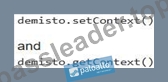
- A. Create a new XSOAR Integration that wraps the rate-limited service and implements the caching logic internally using XSOAR's built-in key-value store (
- B. Implement caching logic within each Script that calls the rate-limited service, storing data in the incident context and clearing it with a scheduled Job.
- C. Develop a dedicated Python Script, exposed as a command, which handles all calls to the rate-limited service, implements caching in-memory, and is called by other Scripts.
- D. Utilize a Job that periodically fetches data from the rate-limited service, stores it in a global XSOAR list, and then Scripts query this list.
- E. Modify the XSOAR server configuration to enable an external Redis cache that all Scripts and Integrations can directly access.
Answer: A
Explanation:
The most scalable and maintainable approach is to create a new XSOAR Integration (or modify an existing one) that wraps the rate-limited service and implements the caching logic internally. This is because: 1 . Integrations are the proper place to abstract external API interactions and manage their state/caching. 2. XSOAR's key-value store (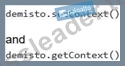
at the integration level, not incident context) provides a persistent, shared storage accessible across multiple executions of the integration commands. 3. This approach centralizes the caching logic, making it reusable by any playbook or script that uses this integration, and ensures proper expiry. Option A is problematic because incident context is per-incident, not global, and clearing it with a Job is inefficient. Option C uses lists, which are not designed for efficient key-value lookups and expiry for caching. Option D is not a standard XSOAR practice for internal caching and introduces external dependencies. Option E (in-memory caching in a script) would not persist across different script executions or even different playbook runs, making it ineffective for a global cache.
NEW QUESTION # 43
During a data ingestion health check in Cortex XSIAM, a security engineer observes a significant drop in firewall logs being ingested from a critical perimeter firewall cluster. Upon investigation, they confirm the firewalls are still generating logs, and network connectivity to the Log Collector is stable. Reviewing the Log Collector's logs, they find entries indicating 'Malformed event received' and 'Parsing error, dropping event.' Which of the following is the most likely root cause and the immediate action to take to restore ingestion while troubleshooting the parsing issue?
- A. The Log Collector service has crashed or is unresponsive. The immediate action is to restart the Log Collector service. The malformed event message is a secondary symptom.
- B. A network security group or firewall rule is blocking traffic on the syslog port between the firewall and the Log Collector. The immediate action is to check and modify network security rules.
- C. The firewall firmware was recently updated, changing the log format. The immediate action is to update the Log Profile's parsing rule to match the new format.
- D. The firewall's log forwarding destination IP address was changed, causing logs to be sent elsewhere. The immediate action is to update the firewall's logging configuration.
- E. The Log Collector's disk space is full, preventing new logs from being written. The immediate action is to clear disk space and restart the Log Collector service.
Answer: C
Explanation:
The key indicators here are 'Malformed event received' and 'Parsing error, dropping event' observed in the Log Collector's logs, despite confirmed log generation and network connectivity. This strongly suggests that the logs are reaching the collector, but their format no longer matches the expected parsing rule. The most common reason for a sudden change in log format for network devices like firewalls is a firmware update (A). The immediate action is to update the Log Profile's parsing rule in XSIAM to correctly interpret the new log format. Other options are less likely given the specific error messages: Disk space (B) would typically show 'disk full' errors, not parsing errors. IP address change (C) or network blocking (D) would result in no logs reaching the collector at all. Service crash (E) would prevent any log processing, and the error messages would likely be different (e.g., service unavailable), not specific parsing errors for received events.
NEW QUESTION # 44
Consider a scenario where Cortex XDR has detected an XDR Story with the verdict 'Malicious' involving a series of events: 'Outlook.exe' launched 'cmd.exe', which then executed 'mshta.exe' to run a remote HTA file, subsequently dropping and executing 'evil.exe'. The 'evil.exe' then attempted to establish a C2 connection to an external IP. Which of the following statements accurately describe how the Causality View enhances the investigation of this XDR Story and why it's critical for a Security Operations Professional?
- A. It presents a chronological, interactive graph of the process tree, showing 'Outlook.exe' as the root, branching to 'cmd.exes, then 'mshta.exe', and finally 'evil.exe' , allowing the analyst to trace the entire attack flow and identify the initial compromise vector.
- B. The Causality View aggregates all raw logs from each event into a single, searchable text file, simplifying log analysis without visual representation.
- C. The Causality View focuses solely on network connections, providing a real-time map of all active connections established by 'evil.exe', irrespective of its parent processes.
- D. It provides a direct 'one-click' remediation button that rolls back all system changes made by the malicious processes to a pre-infection state, negating the need for detailed investigation.
- E. The Causality View automatically quarantines all related files and terminates all processes within the XDR Story, requiring no further manual intervention from the analyst.
Answer: A
Explanation:
The Causality View is paramount for understanding complex XDR Stories. Option B accurately describes its core function: presenting an interactive, chronological graph of related processes and events. This allows a Security Operations Professional to visualize the entire attack chain, from the initial trigger ('Outlook.exe' launching 'cmd.exe' due to a malicious attachment or link) to the final malicious activity ('evil.exe' establishing C2). This visual understanding of the sequence of events, including parent-child relationships and associated network/file/registry activities, is crucial for determining the attack's scope, identifying persistence mechanisms, and formulating effective containment and eradication strategies. Options A, C, D, and E either misrepresent the Causality View's functionality or describe automated actions that might follow an investigation but are not the primary purpose of the view itself.
NEW QUESTION # 45
......
SecOps-Pro Study Material, Preparation Guide and PDF Download: https://examcertify.passleader.top/Palo-Alto-Networks/SecOps-Pro-exam-braindumps.html